
The invisible magic of the Red Sea: how corals communicate – and what divers really see
When we divers talk about the Red Sea, we almost always talk about visibility, colours, schools of fish or iconic spots such as the Dahab Canyon or the Blue Hole Sinai. But there is much more going on beneath the surface – something that escapes us at first glance: corals communicate. And they do so in incredibly complex ways.
In this article, we take you on a journey into a world of light signals, chemical messages, fluorescent colours and even sounds. An invisible language that influences the entire ecosystem – and one that you can experience live in Dahab if you know what to look out for.
Corals – animals that communicate silently with each other
Corals are not plants, but animals that live in highly organised communities. And they are in constant contact with each other:
Chemical communication:
Corals emit molecules to inform neighbours about stress, enemies or changes.
Fluorescent light signals:
Under UV light, many corals react with bright colours. This invisible communication serves to protect, camouflage or attract certain organisms.
Sounds of the reef:
A healthy reef crackles, creaks and hums – not loudly, but unmistakably. These sounds serve as orientation aids for coral larvae searching for a new home.
These signals are not always visible, but they shape life on the reef every second.
How this magic manifests itself in Dahab – a reef full of light, sound and movement

Dahab is an ideal place to observe the language of corals. Thanks to clear conditions, diverse reefs and calm spots, the Sinai offers perfect opportunities to experience these phenomena first-hand.
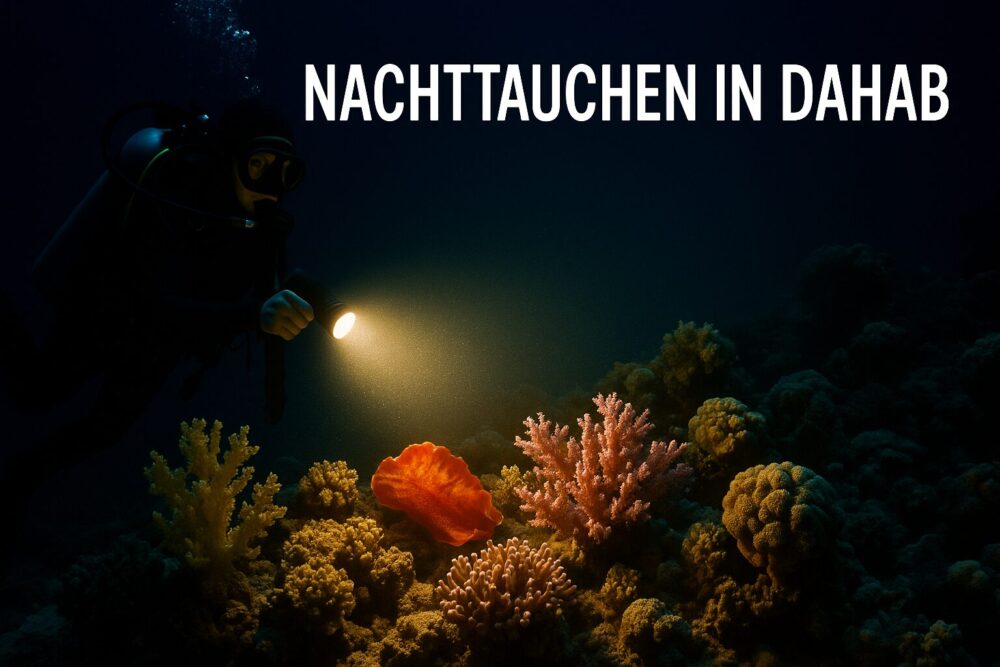
Fluorescent corals at night:
With the right lamp, the reef begins to glow – shades of green, blue and violet that are completely invisible during the day.
Polyp behaviour in real time:
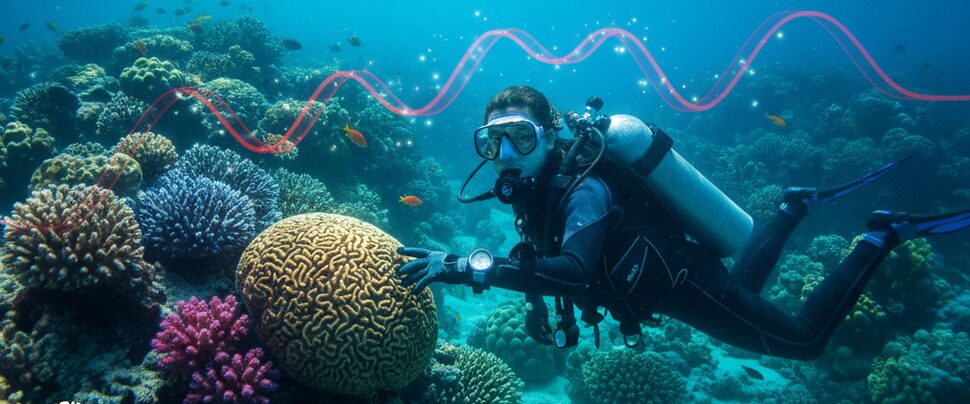
At Dahab’s house reef, you can observe how corals react when approached: polyps retract, colours change, and mucus layers form.
The sound of the reef:
Hover quietly above the reef for a few minutes – and you will hear it. The famous crackling sound is a sign of a healthy ecosystem.
The sensory world of corals – and what you perceive as a diver
When you recognise the invisible language of corals, a whole new perspective opens up underwater:
• Polyps open up to feed at night
• Corals retreat when disturbed
• Colour changes indicate stress or light adjustments
• Slime layers serve as a protective mechanism
• Fluorescence intensifies depending on UV intensity
The best places in Dahab to experience the invisible magic
House reef Dahab:
Perfect for night and fluorescent dives. Very diverse coral gardens.
Canyon Dahab:
Spectacular geology meets vibrant coral structures. The play of light enhances fluorescence and colours.
Blue Hole:
One of the clearest spots in Sinai – ideal for observing the dynamic coral life rich in polyps.
More information or direct booking: www.lagona-divers.com/en/rates-and-booking/
Conclusion
Corals communicate – not with words, but with light, colour, chemistry and sound.
The more we engage with these signals, the more intensely we experience Dahab’s reef, which tells a new story with every dive.
The Red Sea is not a quiet place – it is a vibrant network.
Did you enjoy this article and want more? Sign up for our newsletter, which is sent out a few times a year and is always interesting, with nice additional discounts for our readers: