
Spotted, elegant, enormous – when the stingray passes through the Lighthouse
No dive like any other
It’s one of those dives where you don’t really expect anything. Just jump in the water and dive down.
Not directly at the house reef – this time we head a few minutes towards Dahab centre, to Lighthouse Reef. A spot that is known for everything and nothing – sometimes quiet, sometimes full of life.
You glide across the plateau, the sun painting vibrant patterns on the sand.
And then: shadows. Moving, calm. It takes a few seconds for your mind to comprehend what your eyes have already seen.
A stingray – majestic and mysterious.
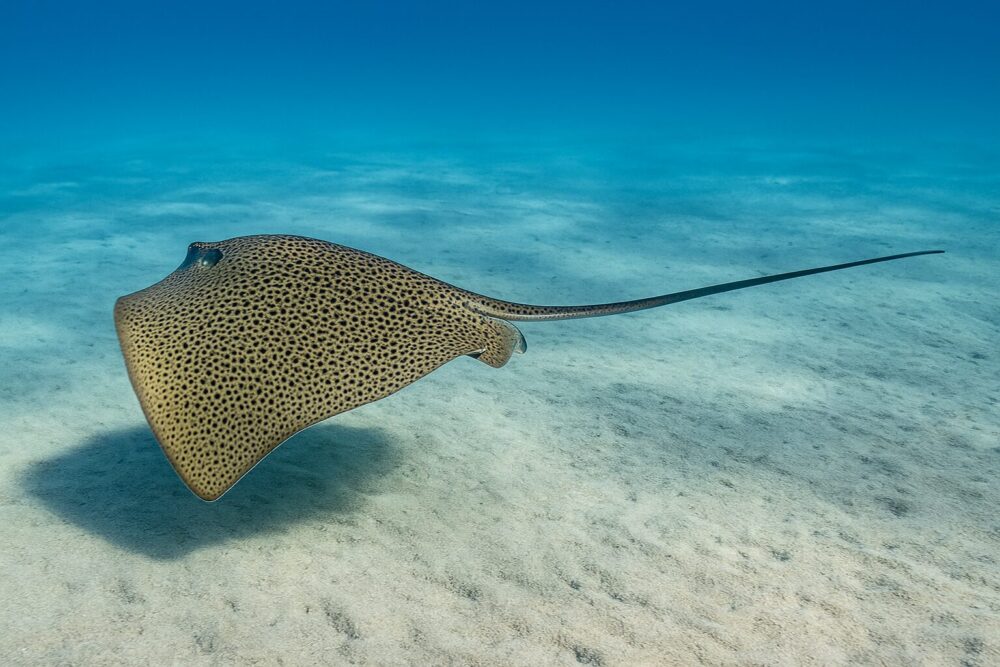
It glides along less than two metres below you. A giant, covered with a fine network of dots. Slowly, gracefully. Almost as if in slow motion.
And you? You forget everything around you.
The magic of quiet encounters
It’s not the size that impresses you. Nor is it the wingspan or the delicate pattern.
It is the calmness of this ray, its serene movement. As if the sea belonged to it – and anyone who enters it must first introduce themselves.
You stand still. Or float, rather. And you hope that this moment will never end.
The ray moves on. You don’t follow. Because you know: this was a gift.
What makes the net ray so special?
The reticulated whipray (Himantura uarnak) is a large, shy creature with a distinctive net-like pattern of spots on its back, which in adult animals forms densely packed dark spots on a light background.
During the day, it often lies motionless on the sea bed, sometimes even buried in the sand. As a bottom feeder, it mainly feeds on invertebrates living on the sea bed and small bony fish.
With a wingspan of up to 2 metres and an extremely long, thread-like tail (usually 3–3.5 times the width of the disc), equipped with a sting, it is an impressive sight.
How to behave correctly when fishing with a net
- Hover over him, but remain calm and respectful. He needs space.
- No frantic fin strokes. Calmness encourages interaction.
- Enjoy the distance. As a rather down-to-earth loner, he is not a sociable swimmer.
Why Lighthouse Reef is still a favourite spot
Our own house reef at Happy Life Village is beautiful. Triple Pools, Golden Blocks and the Lagona Divers house reef offer fantastic entry points, colourful corals and great conditions – right on our doorstep.
But sometimes we deliberately drive a few minutes further: to Lighthouse Reef in the heart of Dahab.
Not because it is better, but because it is different.
And because it is precisely there that encounters such as the one with the stingray are possible – quiet, unexpected, impressive.
We are often there. And we will take you with us, of course, if you feel like it.
Book your dive now →
Unsere Empfehlung
When you’re in Dahab: Do as the stingray does.
Take it easy. Dive without pressure. And look closely – often the greatest experience is not far away.
See you underwater.
Fact box: Reticulate Whipray (Himantura uarnak)
| feature | Beschreibung |
|---|---|
| Scientific name | Himantura uarnak (Reticulate Whipray) |
| Size | Up to approx. 2 m span, total length up to approx. 6 m |
| Pattern | Dark spots on a light background, net-like |
| Habitat | Sandy areas, lagoons, reefs, up to approx. 50 m depth, also in the Red Sea |
| Behaviour | Often motionless on the ground during the day, active at night |
| Nutrition | Invertebrate bottom dwellers, small fish |
| Reproduction | Aplacental viviparous, up to 5 young |
| Status | Endangered (IUCN Red List) |