
The clownfish is shrinking!
Clownfish: The little heroes of the seas and their amazing shrinking phenomenon
Welcome to the fascinating world of clownfish! These colourful sea creatures, which we can confidently call our ‘pets’ in Dahab, have more to offer than just their charming appearance and symbiotic relationship with sea anemones. Did you know that clownfish can shrink in hot weather? Sounds crazy, doesn’t it? Let’s take a closer look at this amazing phenomenon.
The little heroes of the seas
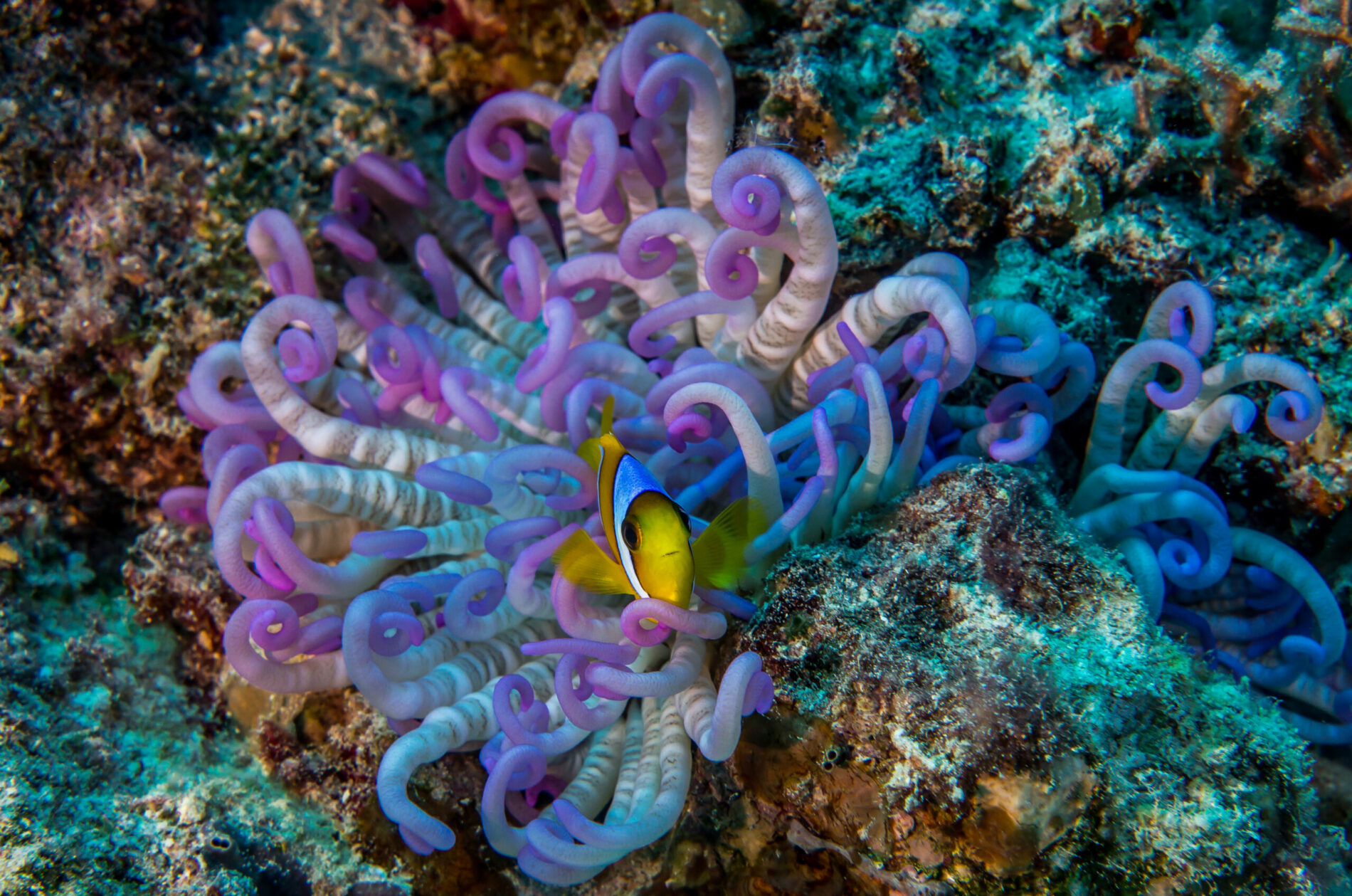
Clownfish, also known as anemonefish, belong to the reef fish family and are found right on our doorstep at depths that allow us to get close to them even when snorkelling. With their bright colours and characteristic white stripes, they are not only eye-catching, but also masters of adaptation. They live in a symbiotic relationship with sea anemones, which offer them protection from predators, while the anemones are cleaned by the clownfish.
The shrinkage phenomenon
Now for the big question: why do clownfish shrink in hot weather? This phenomenon is actually a survival strategy. As water temperatures rise, which is becoming increasingly common due to climate change, clownfish need to use their energy more efficiently. A smaller body requires less energy and oxygen, which is advantageous in warmer waters.
The science behind it
The shrinking of clownfish in heat is a fascinating and complex phenomenon that has been examined in detail through scientific research. Here are some key findings:
Researchers have discovered that clownfish begin to shrink during heat waves in the ocean to improve their chances of survival. This adaptation helps them to cope better with heat stress. The research was conducted mainly in the coral reefs of the Indo-Pacific, where clownfish are native. Clownfish produce fewer growth hormones at higher temperatures. This causes them to grow more slowly or even shrink. It is an impressive example of how flexible and adaptable nature can be. If you want to know more about this, read the section at the end of my post.The shrinking of clownfish in heat is a fascinating and complex phenomenon that has been examined in detail through scientific research. Here are some key findings:
Researchers have discovered that clownfish begin to shrink during heat waves in the ocean to improve their chances of survival. This adaptation helps them to cope better with heat stress. The research was conducted mainly in the coral reefs of the Indo-Pacific, where clownfish are native. Clownfish produce fewer growth hormones at higher temperatures. This causes them to grow more slowly or even shrink. It is an impressive example of how flexible and adaptable nature can be. If you want to know more about this, read the section at the end of my post.
A call to action
While the shrinking of clownfish is a fascinating adaptation, it also reminds us how much climate change is affecting marine life. It is a wake-up call that we need to do more to protect our oceans and combat climate change.
Fazit
Clownfish are not only charming sea creatures, but also true survivalists. Their shrinking phenomenon in heat shows how adaptable they are and how important it is to protect their habitats. So, next time you see a clownfish, remember how amazing these little heroes really are!
If you want to see our life-size clownfish, come visit us as soon as you can! If you want to know who else lives on our doorstep, check out this post: The lionfish.
The study in detail
A research team led by Melissa Versteeg from Newcastle University studied 67 wild clownfish pairs from Kimbe Bay in Papua New Guinea [1] [2]. During a five-month heatwave from February to August 2023, the length of the 134 clownfish was measured monthly and the water temperature was recorded every four to six days.
Results of the study
Over the course of five months, 100 of the 134 fish shrank. Some shrank only once by a few millimetres, others shrank several times, and around a quarter did not shrink at all. Interestingly, the fish often shrank in pairs, meaning that when the female shrank, the male also shrank. This helped to maintain the size ratio within the pairs and avoid conflicts.
survival advantage
The study showed that the survival probability of the shrinking fish was up to 78 per cent higher than that of their non-shrinking counterparts [1] [2]. Shrinking is therefore an effective strategy for surviving heat stress.
Fazit
The shrinking of clownfish in heat is an impressive example of nature’s adaptability. These scientific studies help us to better understand the effects of climate change on marine life and underscore the need to protect our oceans.
References
[1] Heat waves in the sea cause clownfish to shrink
[2] Clownfish shrink in heat, according to study – Watson